
Retailers have spent years optimising the path to purchase. But what happens after the sale is now emerging as one of the most powerful, and underutilised, growth levers in eCommerce today.
The latest insights from Webloyalty and RetailX’s Post-Purchase Monetisation 2026 report show that post-purchase monetisation is no longer a tactical add-on. It is becoming a strategic cornerstone of retail media, customer retention and long-term value creation.
And the reason is simple: the confirmation page is no longer the end of the journey; it’s the start of the next one.
The confirmation page: from receipt to revenue engine
It costs more to acquire new customers than it does to retain existing ones.
For years, retailers treated the order confirmation page as a functional endpoint, acting as a digital receipt before customers exit the site. Today, that mindset is outdated.
Every customer passes through this moment. Trust has just been established, engagement is high, and attention is guaranteed. In a landscape where acquisition costs are rising and consumer attention is increasingly fragmented, this makes the confirmation page one of the most valuable pieces of retail real estate available.
Retailers are now recognising this shift. Instead of viewing conversion as the finish line, they are treating it as the start of a second opportunity. This becomes a chance to drive incremental revenue, strengthen relationships and influence future behaviour.
Consumer appetite is there but execution is everything
One of the most encouraging findings from the report is just how open consumers are to post-purchase engagement.
Nearly 90% of consumers are willing to engage with post-purchase offers under the right conditions.
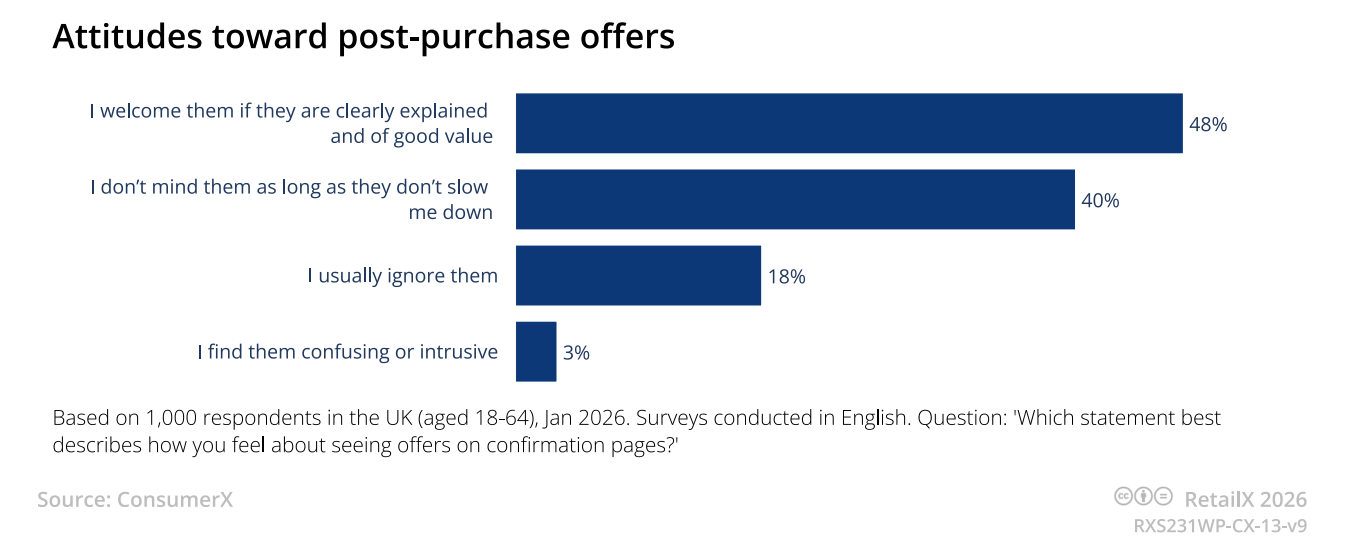
But there’s a clear caveat: relevance is non-negotiable.
Consumers are not engaging habitually; they are engaging selectively. They respond to offers that feel contextual, useful and easy to understand. When execution is poor or offers are irrelevant, even a strong concept quickly becomes background noise.
This presents both the opportunity and the challenge:
- Fewer, better offers outperform higher volumes
- Clarity drives trust and engagement
- Relevance determines performance
At ODEON, a strategy focused on delivering relevant, complementary and unobtrusive post-purchase offers helped drive an 84% increase in secondary revenues
Deepal Parmar, Senior Sales Manager, ODEON
Value, not volume, drives engagement
This becomes even clearer when you look at the types of offers that resonate the most. Consumers are not looking for more options; they are looking for better ones. Offers that deliver ongoing, tangible value consistently outperform one-off promotions. Discounts on future purchases, loyalty rewards and cashback propositions all stand out because they extend the benefit of the original transaction rather than interrupt it.
The report shows that consumers overwhelmingly prefer offers that deliver tangible, ongoing value, such as:
- Cashback and savings propositions
- Discounts on future purchases
- Loyalty rewards
These consistently outperform generic third-party promotions. Crucially, it’s not just about immediate savings. More than three quarters of consumers say long-term savings are very or extremely important.
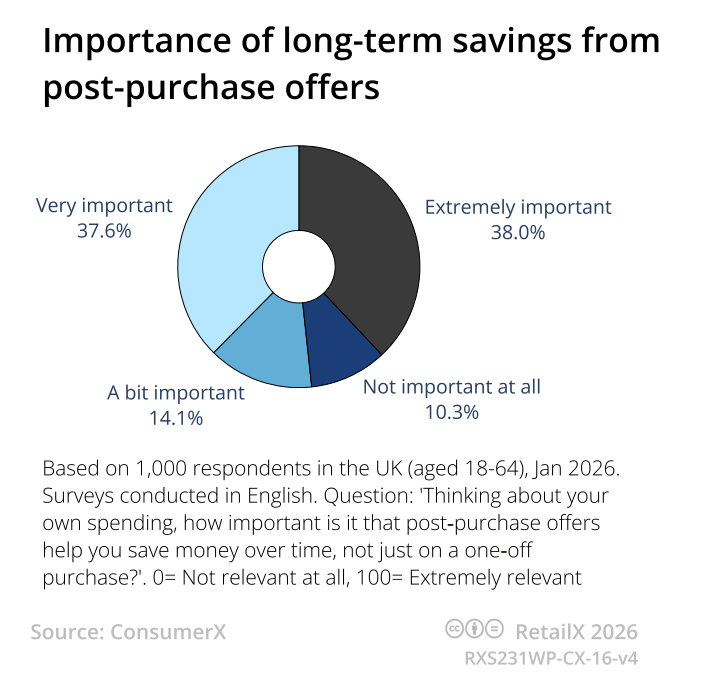
This marks a significant shift in mindset. Shoppers are moving beyond one-off incentives and increasingly prioritising cumulative value such as rewards, memberships and ongoing benefits that extend beyond a single transaction.
For retailers, this is where post-purchase starts to move beyond simple monetisation. It becomes a way to reinforce the customer’s decision, deepen the relationship and create a reason to return — without relying on constant discounting.
Why this moment matters even more in an AI-driven world
Looking ahead, the importance of post-purchase is only set to grow.
As AI reshapes how consumers discover and evaluate products, more of the traditional journey is moving outside retailer-controlled environments. Customers are increasingly researching, comparing and even shortlisting purchases before they ever reach a website.
That shift reduces the number of touchpoints where retailers can influence behaviour directly. This shift in consumer behaviour arguably makes the confirmation page the single most-important part of the purchase.
We generate between 20–30% of our retail media revenue through non-endemic post-purchase partnerships, demonstrating just how commercially significant this moment can become when executed effectively
Ekow Mensah, VP Retail Media, Secret Sales
At the same time, AI is also improving the quality of post-purchase interactions themselves. Instead of relying on broad or generic placements, retailers can deliver fewer, more relevant offers based on context, behaviour and likely intent. The result is not more activity, but better activity with interactions that feel integrated into the experience rather than layered on top.
Turning the end of a journey into the start of something more
What this all points to is a fundamental shift in perspective. Retailers have traditionally treated the checkout space as the finish line, where the value is captured and the interaction concludes. But the data increasingly suggests that the most important work may begin immediately afterwards.
Handled well, post-purchase engagement does not disrupt the experience. It completes it. It reassures the customer, reinforces the value of their decision and creates a bridge to what comes next. In an environment where acquisition is expensive, competition is intense and attention is limited, that ability to extend the relationship, without starting from scratch, is hugely powerful.
The opportunity is not to add more steps to the journey, but to make better use of the moment that already exists.
Download the full report
The full Post-Purchase Monetisation report explores how leading retailers are turning confirmation pages into high-performing revenue and retention channels.
Download the report to discover:
- The latest consumer research and engagement trends
- Which post-purchase strategies are delivering the strongest results
- Real-world examples from retailers successfully monetising the confirmation moment
- Practical insights on how to optimise relevance, value and performance