
The uncertain fiscal environment in the UK means consumers are ultra cautious about discretionary spending. And all the while, there are now more online distractions than ever – ‘the attention economy’ – meaning retailers and brands must work doubly hard to convert sales in the first place due to increased competition for consumers’ time and share of wallet.
These are not new revelations; it has been the case for some time – but with geopolitical events taking an unexpected turn in 2026 to cause further consumer uncertainty and cost hikes and yet more new arrivals on the UK retail scene, including the April launch of Chinese conglomerate JD.com’s Joybuy platform, this trend is only currently moving in one direction.
Such a perfect storm of events is making the post-purchase part of e-commerce an attractive space in which to double down on monetisation strategy.
That was the premise for a breakfast roundtable in Manchester on 29 April, which involved retail journalist Ben Sillitoe bringing together a group of senior-level retailers on behalf of Webloyalty for a discussion on all things retail.
Representatives from American Golf, B&M, Castore, Co-op, JD Sports, Lights4Fun, N Brown, and Puma joined what was an insightful discussion, delving into just where the opportunities for post-purchase monetisation reside, which are covered in more detail below. Quotes are anonymised reflecting the Chatham House Rules applied to the event discussion.
Sweating Assets and Customer Retention
It costs more to acquire new customers than it does to retain existing ones.
That’s an old mantra in retail that holds weight. And at times when business costs are on the rise and consumer spend is tight, retailers should be doubling down on getting more from those who already shop with them.
Retailers around the table agreed this is certainly one tactic to adopt, and there was an acknowledgement that developing retail media strategies and building more compelling loyalty programmes is one way to sweat existing assets.
One guest said their organisation was looking at digital and technology differently than before. The cultural change at the company means tech investment is seen as “revenue driver” rather than a cost, with the business viewing the experimentation and capital expenditure on tech-influenced approaches as a long-term winning strategy.
Others spoke about the pressing need to use existing communication methods to drive better data into their organisations.
“Capturing the data and getting to know exactly what the customer wants is key to driving continued revenue from your shoppers,” one roundtable attendee noted.
“Hyper-personalisation is the winning strategy because the younger generation expect it,” another guest remarked.
Value-Oriented Customers
One attendee said their teenage children “have never known a boom time in the UK”, underlining the difficult economy retailers have been operating in for more than a decade now.
Another argued: “People are spending less and coming back less frequently – there were some green shoots at the start of 2026 but that momentum burst with global events that have unfolded in the Middle East.”
Such a backdrop emphasises the need to talk to customers about value at all opportunities, and the need for retailers to be competitive on price but also to discount at the right time and in the right places.
Communicating this type of messaging on ‘thank you’ and confirmation emails can get retailers traction because they are already in buying mode and – as one roundtabler identified – “everyone is keen on a little treat no matter what their circumstances, so if you can highlight the value in the key moments, you’ll be able to convert the sale”.
CX in the Age of AI
As more and more of how retailers communicate with customers online becomes automated via chatbots and agentic commerce, which is expected to accelerate in the year ahead, post-purchase comms becomes a moment to provide some humanity.
The email following a sale allows retailers to show their gratitude to shoppers in the most personalised manner. Brands already know what has been purchased, so can present relevant upselling or rewards that – if done well – will make the customer feel seen, heard, and valued.
One guest said consumers are “fatigued” in terms of special offers, subscription services, and loyalty scheme benefits – there are also signs the rise of AI is creating trust issues among consumers, who are now operating in a world where they are uncertain if they are talking to a human or a bot.
It is not that consumers do not want any of these things, the retailer said, “but they will only go for them if the brand in question is able to prove the value at the point they are offering it”.
“This is a challenge for all retailers to pull off in 2026 because consumers cannot be fooled,” he continued.
Evidence of Post-Purchase Comms Power
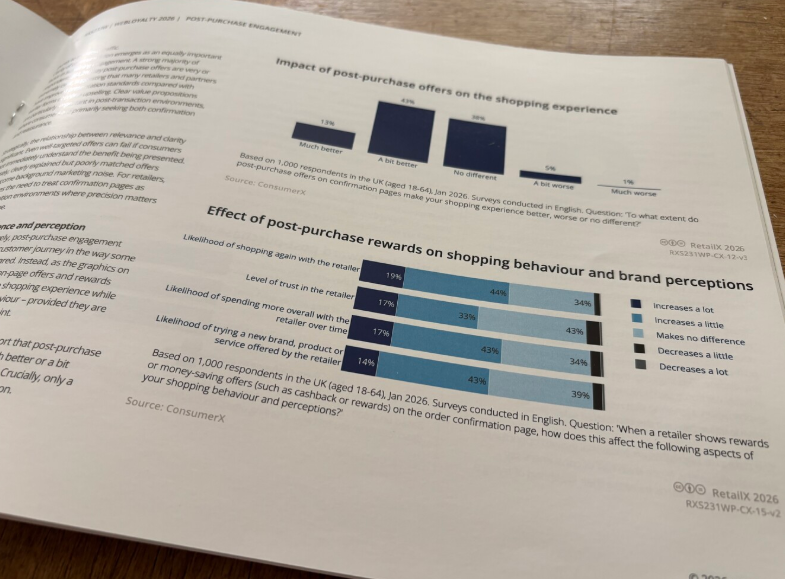
The roundtable delegates were presented with an exclusive version of the Retail X-Webloyalty Post Purchase Monetisation data workbench report, which underlines the power of post-purchase comms when done well.
Some 1,000 adults in the UK were surveyed for the report, and 56% said post-purchase offers on purchase confirmation pages make the shopping experience better. Only 6% said it worsened the CX.
The research showed 40% of consumers view special offers at the post-purchase communication juncture as a helpful way to gain additional value or save money. Discounts on a future purchase with the same retailer and additional loyalty rewards were rated as the most appealing forms of communication.
There’s work to do, however, with 35% of respondents describing post-purchase offers as a helpful idea that is poorly executed. There is also a demand for these offers to be relevant to the individual shopper and not impair the customer journey in any way – the offers and comms needs to be a natural fit, according to those surveyed.
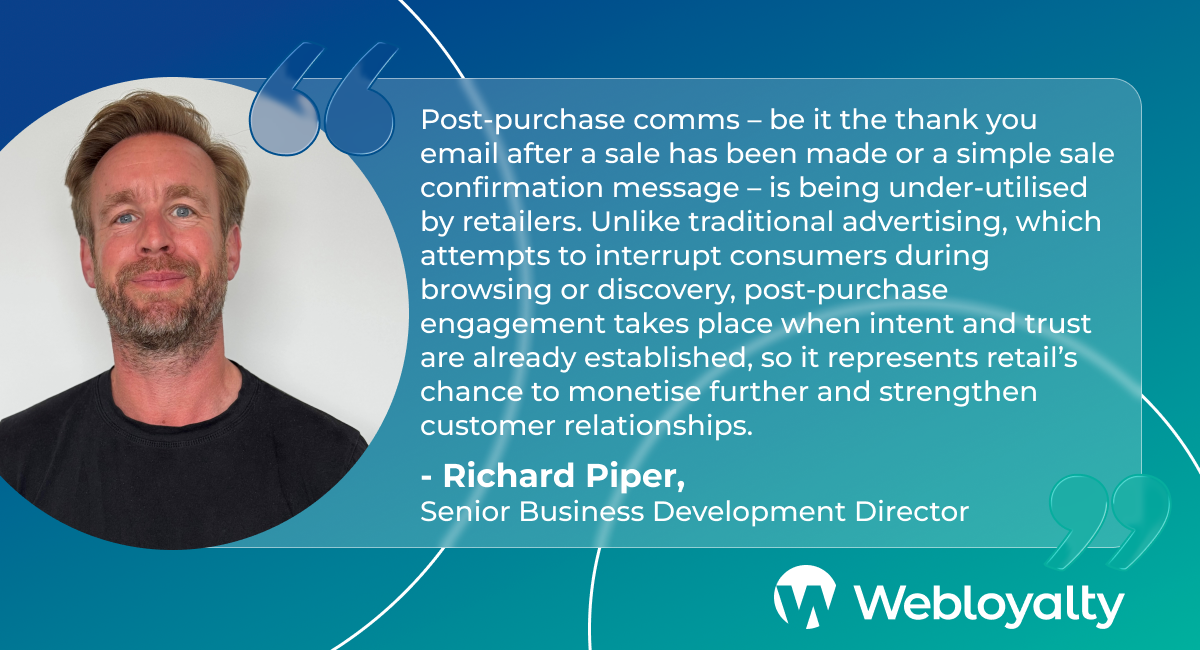
Richard Piper, Senior Business Development Director at Webloyalty, who took part in the roundtable discussion, said: “Modern commerce dictates that retailers have more competition to attract consumers attention than ever before.
“Post-purchase comms – be it the thank you email after a sale has been made or a simple sale confirmation message – is being under-utilised by retailers. Unlike traditional advertising, which attempts to interrupt consumers during browsing or discovery, post-purchase engagement takes place when intent and trust are already established, so it represents retail’s chance to monetise further and strengthen customer relationships.”
See the full version of Webloyalty and RetailX’s 2026 Post-Purchase Monetisation benchwork report here, which provides critical insights, as well as an in-depth overview, of how 1,000 UK consumers are interacting with post-purchase offers; and how leading retailers are turning post‑purchase into a strategic advantage.